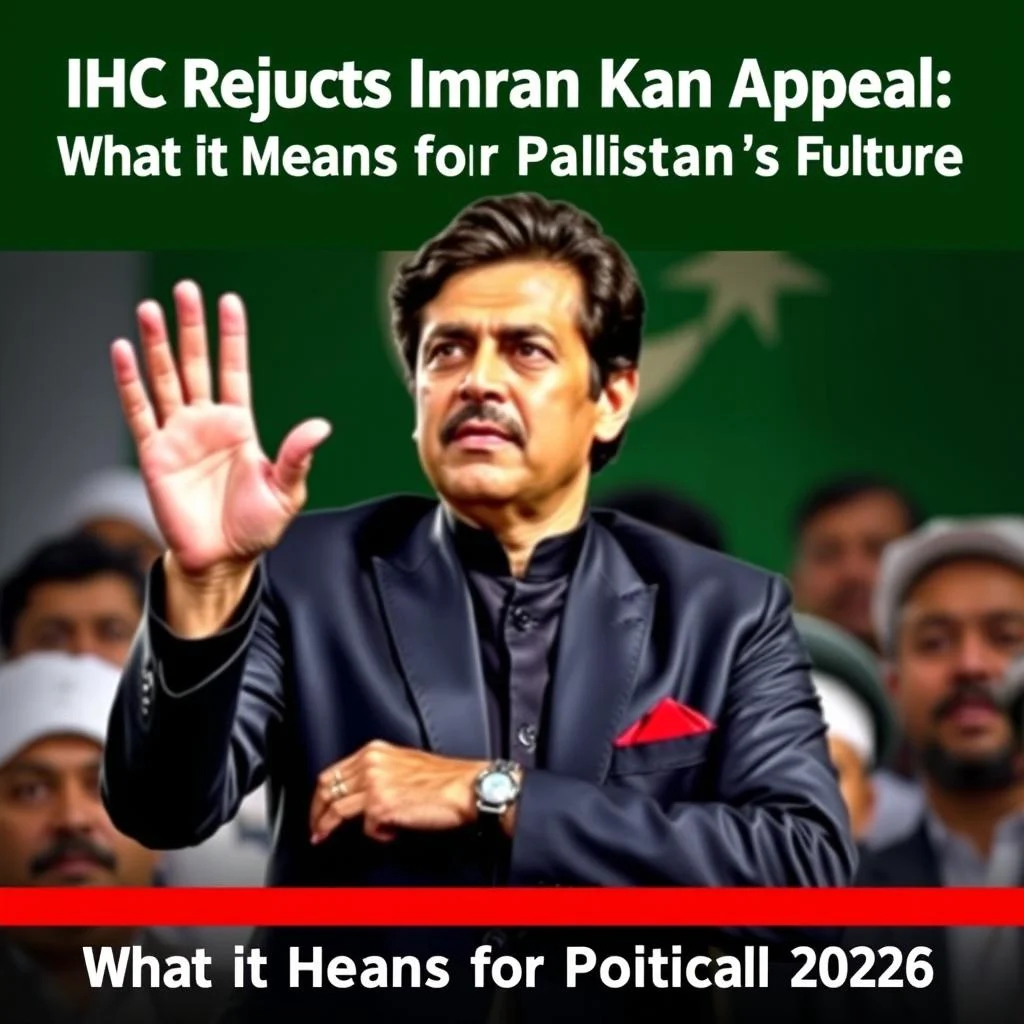
The Islamabad High Court (IHC) has officially rejected former Prime Minister Imran Khan’s appeal challenging his conviction in the Toshakhana case. This decision, handed down on April 5, 2026, marks a significant turning point in Pakistan’s ongoing political turbulence. The court upheld the lower court’s verdict, which found Khan guilty of corruption and sentenced him to three years in prison.
For those unfamiliar, the Toshakhana case revolves around allegations that Khan and his wife, Bushra Bibi, retained expensive state gifts without declaring their full value or paying the required market price. The case has been a focal point of legal and political battles since 2022, when Khan was first ousted from office.
Now, with the IHC rejecting Imran Khan’s appeal, the legal path forward narrows considerably. Supporters of the Pakistan Tehreek-e-Insaf (PTI) party have called the ruling politically motivated, while government officials insist it reflects the rule of law. Either way, this decision will shape the country’s political landscape in the months ahead.
Key Facts About the IHC Ruling
The Islamabad High Court’s decision was delivered by a two-judge bench after weeks of hearings and legal submissions. The court found no procedural errors or constitutional violations in the original trial. It also dismissed claims that the evidence was mishandled or that the trial was unfair.
- Verdict upheld: Imran Khan’s three-year prison sentence remains in effect.
- Disqualification confirmed: Khan is barred from holding public office for five years, as per Pakistani election law.
- No bail granted: The court refused to suspend the sentence pending a potential Supreme Court appeal.
- Bushra Bibi’s case: Her separate appeal was also rejected, though her sentence was reduced from five to two years on humanitarian grounds.
Legal experts note that this ruling closes one major chapter in the Toshakhana saga. “The IHC has made it clear that the lower court’s findings stand,” said senior advocate Ayesha Malik. “Unless the Supreme Court intervenes, Khan will have to serve his sentence.”
Background: How We Got Here
The Toshakhana case dates back to 2018, when Imran Khan was still in office. Toshakhana is a government department that manages gifts received by public officials from foreign dignitaries. These gifts are supposed to be either deposited in the national treasury or purchased by the recipient at market value.
Khan allegedly retained several high-value items—including watches, jewelry, and a watch gifted by the Emir of Qatar—without paying the full assessed price. The Election Commission of Pakistan (ECP) later ruled that he had concealed assets, leading to his disqualification from the National Assembly in 2022.
The case escalated when a district court in Islamabad convicted him in August 2023. That conviction triggered widespread protests from PTI supporters, who accused the military and judiciary of orchestrating a campaign against Khan.
Since then, Khan has filed multiple appeals, challenged the jurisdiction of courts, and even sought international mediation. None have succeeded—until now, with the IHC’s final rejection.
Timeline of Key Events
- 2018–2022: Khan receives and retains Toshakhana gifts during his premiership.
- April 2022: Ousted via no-confidence motion.
- October 2022: ECP disqualifies Khan for concealing assets.
- August 2023: District court convicts Khan; sentences him to three years.
- September 2023: IHC temporarily suspends sentence, allowing bail.
- March 2026: IHC hears final appeal arguments.
- April 5, 2026: IHC rejects appeal, reinstates conviction and sentence.
Why This Ruling Matters
This isn’t just about one man or one case. The IHC’s decision has ripple effects across Pakistan’s legal, political, and social spheres.
First, it reinforces the principle that no one is above the law—at least in theory. For a country with a history of political interference in judicial matters, this ruling sends a mixed signal. Supporters of the current government argue it proves the system works. Critics say it’s selective justice.
Second, it deepens the rift between PTI and the establishment. Khan’s party has already called for nationwide protests. On April 6, rallies were held in Lahore, Karachi, and Peshawar. Police used tear gas in Islamabad to disperse crowds near the Red Zone.
Third, it complicates Pakistan’s upcoming general elections, scheduled for late 2026. With Khan disqualified, PTI must either field a new candidate or risk losing momentum. Internal party divisions are already surfacing, with some leaders pushing for a more confrontational approach.
Public Reaction: Divided Nation
Pakistanis are split. In urban centers like Lahore and Islamabad, many view the ruling as overdue accountability. “He broke the rules like everyone else,” said Farhan Ali, a university student in Rawalpindi. “If we let leaders get away with corruption, nothing changes.”
But in rural Punjab and Khyber Pakhtunkhwa—PTI’s strongholds—sentiment runs hot. “This is a political vendetta,” said Naila Begum, a shopkeeper in Mardan. “They want to silence him because he speaks truth to power.”
Social media reflects this polarization. Hashtags like #IHCRejectsKhanAppeal and #JusticeForImran trended for days. Memes, protest videos, and legal analyses flooded platforms like X (formerly Twitter) and TikTok.
Legal Pathways Still Open?
Yes—but they’re narrow. Khan’s legal team has already announced plans to file an appeal with the Supreme Court of Pakistan. That process could take months, if not longer.
The Supreme Court has the authority to review constitutional questions, procedural flaws, or questions of fundamental rights. However, it rarely overturns lower court verdicts unless there’s clear evidence of bias or error.
Another option is a presidential pardon—but that’s unlikely under the current administration. President Asif Ali Zardari has shown no inclination to intervene in judicial matters.
Some analysts suggest Khan could seek clemency through international bodies, but Pakistan’s courts operate independently of global institutions. The UN or ICC won’t get involved in domestic criminal cases.
What About Political Asylum?
Rumors have swirled that Khan might flee abroad if jailed again. But legal experts say that’s improbable. His passport was confiscated after the initial conviction, and Interpol could issue a red notice if he attempts to leave without court permission.
“He’d be walking into a legal nightmare,” said immigration lawyer Zara Khan. “Even if he reached Dubai or London, Pakistan could request extradition.”
Comparing the IHC Ruling to Past Cases
To understand the significance of this decision, it helps to compare it to similar high-profile appeals in Pakistan’s recent history.
In 2018, former Prime Minister Nawaz Sharif was convicted in the Avenfield case and sentenced to 10 years. His appeal to the IHC was partially successful—the sentence was reduced, but the conviction stood. He eventually served time before being released on medical grounds.
In 2020, former President Pervez Musharraf was declared a fugitive in a treason case. His appeals were dismissed in absentia, and he died in exile without ever facing full justice.
Unlike those cases, Khan’s situation is unique because he remains politically active and widely popular. His ability to mobilize supporters gives him leverage that previous figures lacked.
IHC Rejects Imran Khan Appeal vs Alternatives
Some have asked: Could Khan have avoided this outcome? Legal scholars point to alternative strategies that might have worked—had they been pursued earlier.
- Settlement with NAB: Negotiating a plea deal or asset recovery agreement might have reduced penalties.
- Public apology: Acknowledging oversight (without admitting guilt) could have softened judicial tone.
- Cooperation with investigators: Providing full documentation from the start may have prevented escalation.
But Khan’s team consistently took a confrontational stance, framing the case as part of a broader conspiracy. That strategy rallied his base—but likely hardened judicial attitudes.
Broader Implications for Pakistan’s Democracy
This ruling arrives at a fragile moment for Pakistani democracy. Trust in institutions is low. Voter turnout in the last local elections dipped below 40% in major cities. And economic instability—with inflation hovering near 28%—fuels public frustration.
The IHC’s decision could either stabilize the system by reinforcing judicial independence—or destabilize it further by deepening perceptions of bias.
“Courts must be seen as fair, not just correct,” said political analyst Dr. Sanaa Raza. “When rulings align too closely with government interests, people stop believing in due process.”
Moreover, the timing matters. With regional tensions rising—especially along the Afghan border—and climate disasters straining resources, Pakistan needs unity, not division.
International Response
The U.S., EU, and UK have issued cautious statements urging respect for the rule of law. China, Pakistan’s closest ally, remained silent—a sign of its preference for non-interference.
The International Monetary Fund (IMF), which is negotiating a new bailout package with Islamabad, reportedly views political stability as critical. A prolonged crisis could delay disbursements.
How to Understand the IHC Rejection: A Beginner’s Guide
If you’re new to Pakistani politics or legal systems, here’s a simple breakdown of what happened—and why it matters.
The IHC is Pakistan’s second-highest court, based in the capital. It handles appeals from lower courts and reviews constitutional issues. When it “rejects an appeal,” it means the original verdict stands.
In this case, the original verdict was a guilty finding in a corruption case. The IHC reviewed the evidence, heard arguments, and concluded the trial was fair. Therefore, the conviction remains.
This doesn’t mean Khan is automatically jailed. He can still appeal to the Supreme Court. But unless that higher court intervenes, he must serve his sentence.
For beginners, the key takeaway is this: In Pakistan, even former prime ministers can be held accountable—if the courts allow it. Whether that’s due to law or politics depends on who you ask.
Best IHC Rejects Imran Khan Appeal Guide
To stay informed, follow these steps:
- Read primary sources: Check official IHC judgments on their website.
- Follow credible journalists: Names like Cyril Almeida (Dawn) and Mazhar Abbas offer balanced reporting.
- Avoid echo chambers: Compare PTI-aligned outlets (like Samaa TV) with government-friendly ones (like Geo News).
- Understand legal terms: “Conviction” means found guilty. “Appeal” means asking a higher court to review.
Examples of Similar High-Profile Rejections
This isn’t the first time a major political figure has faced an upheld conviction.
In 2021, former Finance Minister Ishaq Dar was convicted in an assets-beyond-means case. His IHC appeal was rejected, though he remains in London.
In 2023, PTI leader Shah Mahmood Qureshi was convicted in the cipher case. His appeal is still pending, but legal observers expect a similar outcome.
These cases show a pattern: Once lower courts deliver guilty verdicts in high-stakes political cases, appeals often fail—especially when public pressure is high.
What Happens Next?
The immediate future hinges on two things: the Supreme Court’s response and PTI’s strategy.
If the Supreme Court accepts Khan’s appeal, hearings could begin within weeks. A favorable ruling could restore his eligibility for the 2026 elections.
If not, PTI must decide whether to boycott the polls, run a proxy candidate, or escalate protests. Past boycotts have backfired—voter apathy benefits incumbents.
Meanwhile, the government will likely push ahead with economic reforms and security operations. But with unrest simmering, every move will be scrutinized.
Can Khan Still Influence Politics from Prison?
History suggests yes. Nelson Mandela led the ANC from Robben Island. Nelson Rockefeller governed New York while under investigation.
Khan has already used prison time to record videos, write op-eds, and coordinate with allies. His social media team remains active. If he’s incarcerated, expect more digital campaigns—and louder calls for his release.
Frequently Asked Questions
What does it mean when the IHC rejects Imran Khan’s appeal?
It means the Islamabad High Court has upheld the lower court’s guilty verdict. Khan’s conviction and sentence remain in effect unless overturned by the Supreme Court.
Can Imran Khan still run in the 2026 elections?
No. Under Pakistani law, anyone convicted of corruption is disqualified from holding public office for five years. The IHC confirmed this ban.
Is there any way for Khan to avoid jail time?
Only if the Supreme Court overturns the conviction or grants bail. A presidential pardon is theoretically possible but highly unlikely under the current administration.
Why do some people think this ruling is unfair?
Critics argue the case was politically motivated, citing timing (after Khan’s ouster) and selective prosecution. They also claim the evidence was weak and the trial rushed.
How might this affect Pakistan’s economy?
Political instability can deter foreign investment and delay IMF agreements. If protests escalate, markets may react negatively. However, long-term impact depends on whether calm returns quickly.
Final Thoughts
The IHC’s rejection of Imran Khan’s appeal is more than a legal footnote—it’s a defining moment for Pakistan. It tests the strength of its institutions, the resilience of its democracy, and the patience of its people.
Whether you see this as justice served or power abused, one thing is clear: the road ahead won’t be smooth. But for those paying attention, it’s also an opportunity to understand how law, politics, and public opinion intersect in one of South Asia’s most dynamic nations.
And if you’re looking to refresh your home while following these developments, why not start with a luxury guest bathroom makeover? Sometimes, a little calm at home helps process the chaos outside.
Or, if you’re redesigning your space for 2026, check out these modern bedroom ideas—because even in uncertain times, comfort matters.
For small spaces on a budget, this small bathroom luxury guide proves you don’t need wealth to create beauty.