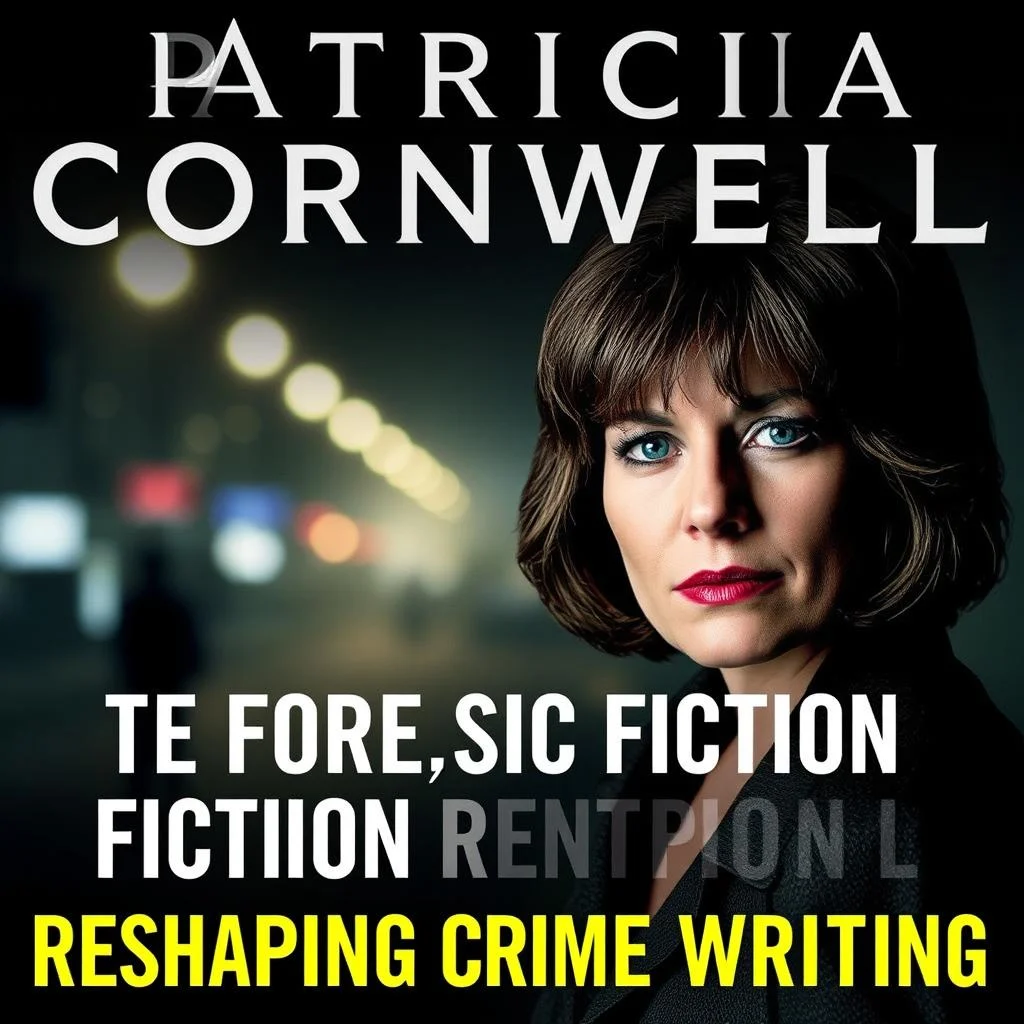
Patricia Cornwell didn’t just write crime novels—she rewrote the entire genre. Before her, forensic details were vague, procedural accuracy was rare, and medical examiners rarely took center stage. Then came Kay Scarpetta, a sharp, relentless chief medical examiner who changed everything. Cornwell’s work didn’t just entertain; it educated, unsettled, and set a new standard for authenticity in crime fiction.
Born in 1956 in Miami, Florida, Cornwell grew up in a family marked by both privilege and turmoil. Her father, a judge, abandoned the family when she was young, leaving her mother to raise three children alone. This early exposure to instability and the legal system planted seeds that would later bloom in her fiction. After studying at Davidson College and earning a journalism degree from the University of North Carolina at Chapel Hill, Cornwell landed a job at The Charlotte Observer. But it wasn’t long before she shifted focus—toward the darker corners of human behavior.
Her big break came in 1990 with the publication of Postmortem, the first book in what would become the iconic Patricia Cornwell Scarpetta series. The novel introduced Dr. Kay Scarpetta, a brilliant, no-nonsense forensic pathologist based in Richmond, Virginia. What set Cornwell apart wasn’t just the character—it was the meticulous detail. She didn’t just describe autopsies; she walked readers through them, step by step, with a precision that felt less like storytelling and more like a medical textbook come to life.
Readers were hooked. Critics were stunned. And the publishing world took notice. Postmortem won the Edgar Award for Best First Novel, a rare honor that signaled Cornwell wasn’t just another crime writer—she was a force.
| Key Takeaways |
|---|
| Patricia Cornwell pioneered forensic crime fiction with the Scarpetta series. |
| Her books blend real science with gripping narrative—no fluff, just facts. |
| The Scarpetta series includes over 20 novels, each building on forensic innovation. |
| Cornwell’s work has inspired TV adaptations and real-world forensic training. |
| She remains active in 2026, continuing to influence crime writing and true crime culture. |
The Birth of a Genre: How Patricia Cornwell Changed Crime Fiction
Before Cornwell, crime novels leaned heavily on detectives with troubled pasts, moody atmospheres, and dramatic confrontations. Forensics? Barely mentioned. Autopsies? Skipped over. But Cornwell knew better. She had spent years researching real forensic techniques, shadowing medical examiners, and interviewing law enforcement. She didn’t want to write about crime—she wanted to solve it, one page at a time.
Her breakthrough came when she decided to center her stories not on a cop, but on a medical examiner. At the time, it was radical. Medical examiners were background players in most crime fiction. Cornwell made Kay Scarpetta the hero. And she didn’t just give her a job—she gave her a voice, a past, and a relentless drive for truth.
What’s more, Cornwell didn’t rely on clichés. She avoided the “brilliant but broken detective” trope. Instead, Scarpetta was professional, methodical, and deeply human. She made mistakes. She questioned her own conclusions. She struggled with ethics, politics, and personal loss. This realism resonated with readers—and with professionals in the field.
In fact, many forensic experts credit Cornwell with sparking public interest in their work. “She made us visible,” said Dr. Henry Lee, a renowned forensic scientist who consulted with Cornwell early in her career. “Before her, people thought autopsies were just about cutting bodies open. She showed the world how much science, logic, and care goes into every case.”
Cornwell’s research process was obsessive. She visited morgues, attended autopsies, and studied case files. She even had a private lab built at her home to test forensic theories. This dedication paid off. Her descriptions of blood spatter, toxicology reports, and decomposition timelines were so accurate that law enforcement agencies began using her books as informal training tools.
By the mid-1990s, the Patricia Cornwell Scarpetta series had become a cultural phenomenon. Each new release topped bestseller lists. Readers didn’t just want more Scarpetta—they wanted to understand the science behind her work. Cornwell delivered, blending narrative tension with educational depth.
Patricia Cornwell Books in Order: A Journey Through the Scarpetta Universe
If you’re new to Cornwell’s world, the best place to start is with the original Scarpetta novels. These books follow Kay Scarpetta’s career from her early days in Richmond to her later roles in Boston and beyond. The series is best read in order, as each book builds on character development, forensic advancements, and ongoing personal arcs.
Here’s a breakdown of the core Patricia Cornwell Scarpetta series in order:
- Postmortem (1990) – The debut that introduced Scarpetta and the serial killer known as the “Templeton Killer.”
- Body of Evidence (1991) – Scarpetta investigates the murder of a bestselling author with ties to her past.
- All That Remains (1992) – A triple homicide leads Scarpetta into a web of political corruption.
- Cruel and Unusual (1993) – Scarpetta faces a case involving a death row inmate and a possible wrongful conviction.
- The Body Farm (1994) – Based on the real University of Tennessee’s research facility, this novel explores decomposition science.
- From Potter’s Field (1995) – Scarpetta uncovers a connection between homeless deaths and a powerful corporation.
- Cause of Death (1996) – A bombing at a funeral home kicks off a high-stakes investigation.
- Unnatural Exposure (1997) – Scarpetta battles a killer who targets victims with rare diseases.
- Point of Origin (1998) – Arson and forensic fire analysis take center stage.
- Black Notice (1999) – Scarpetta travels to Europe to identify a body with no fingerprints or dental records.
- Trace (2004) – A cold case resurfaces, forcing Scarpetta to confront her own past.
- Predator (2005) – A killer uses advanced technology to evade detection.
- Blow Fly (2007) – Scarpetta retires but is pulled back into a case involving a missing child.
- The Scarpetta Factor (2009) – Scarpetta is accused of a crime she didn’t commit.
- Red Mist (2011) – A former FBI agent becomes a suspect in a series of brutal murders.
- Roller Coaster (2013) – Scarpetta investigates a theme park accident that may not be an accident.
- Flesh and Blood (2014) – A new killer emerges, and Scarpetta’s niece, Lucy, plays a key role.
- Depraved Heart (2015) – Scarpetta faces a killer obsessed with J. Robert Oppenheimer.
- Chaos (2016) – A terrorist plot unfolds during a political convention.
- Autopsy (2021) – Scarpetta returns to Richmond to solve a case involving a missing girl.
Beyond the main series, Cornwell has written standalone novels and spin-offs, including the Andy Brazil series and the Win Garano books. But the Scarpetta novels remain her most influential work.
One reason the series endures is its evolution. Early books focused on basic forensic techniques—fingerprinting, ballistics, autopsy procedures. As science advanced, so did Cornwell’s writing. Later novels incorporate DNA analysis, digital forensics, and even artificial intelligence. She doesn’t just keep up with technology—she anticipates it.
For example, in Predator, Cornwell explores how killers can use the internet to stalk victims and cover their tracks. In Chaos, she delves into cybersecurity and data manipulation. These themes weren’t mainstream in crime fiction when she started—but now, they’re essential.
Patricia Cornwell True Crime: The Real-Life Inspiration Behind the Fiction
Cornwell didn’t just invent forensic drama—she lived it. Her fascination with true crime began early. As a young journalist, she covered the trial of serial killer Ted Bundy. The experience left a lasting impression. “I saw how easily the system could fail,” she later said. “How evidence could be mishandled, how witnesses could be ignored. That’s when I knew I wanted to write about justice—not just crime.”
This passion led her to investigate real cases in depth. One of her most controversial projects was her years-long obsession with Jack the Ripper. Cornwell became convinced that the infamous killer was actually Walter Sickert, a British painter. She spent millions of dollars funding forensic tests on Ripper-era letters, including DNA analysis of saliva on envelope seals.
Her 2002 book, Portrait of a Killer: Jack the Ripper—Case Closed, presented her theory. While many historians and criminologists dismissed her conclusions as speculative, Cornwell stood by her research. “I’m not saying I have all the answers,” she said. “But I’m saying we should keep looking.”
Whether right or wrong, her work brought renewed attention to cold cases. It also blurred the line between fiction and reality—something that would define her career. Readers began to see her not just as a novelist, but as an investigator in her own right.
Cornwell’s true crime work also influenced her fiction. The Ripper investigation inspired elements in Black Notice and Depraved Heart, where historical crimes intersect with modern forensics. She often uses real forensic breakthroughs as plot devices, grounding her stories in actual science.
In 2023, she launched a podcast, Scarpetta: The Podcast, where she discusses real cases, interviews experts, and explores forensic mysteries. The show has been praised for its depth and accuracy, further cementing her role as a bridge between fiction and fact.
Patricia Cornwell Movies and TV Adaptations: From Page to Screen
Given the popularity of her books, it’s no surprise that Hollywood came calling. Over the years, several attempts have been made to adapt the Scarpetta series for film and television.
The first major adaptation was the 2008 film At Risk, based on one of Cornwell’s standalone novels. It starred Andie MacDowell and was released as a Lifetime movie. While it received mixed reviews, it proved there was audience interest.
More significantly, in 2022, Amazon Prime Video announced a multi-season series based on the Scarpetta books. The show, simply titled Scarpetta, stars Oscar winner Patricia Cornwell as a consultant and executive producer. The first season, released in late 2023, focuses on the early books, particularly Postmortem and Body of Evidence.
The series has been praised for its authenticity. Medical procedures are shown in detail, often using real forensic equipment. The dialogue mirrors Cornwell’s prose—precise, clinical, and emotionally charged. Critics have noted that the show doesn’t shy away from the grim realities of autopsies or the bureaucratic challenges Scarpetta faces.
One standout episode recreates the “Templeton Killer” case from Postmortem, using actual crime scene photos (with permission) and consulting with real forensic pathologists. The result is a chilling, immersive experience that feels more like a documentary than a drama.
Cornwell herself has been deeply involved in the production. She reviews scripts, advises on forensic accuracy, and even appears in cameos. “I want this to be right,” she told The New York Times in a 2023 interview. “Not just entertaining—but truthful.”
The success of the series has reignited interest in her books. Sales of the Scarpetta novels surged by 300% in 2024, according to Nielsen BookScan. New readers are discovering the series, while longtime fans are revisiting the books with fresh eyes.
There’s also talk of a film adaptation of Depraved Heart, with a major studio in negotiations. If it happens, it could bring Cornwell’s work to an even wider audience.
The Legacy of Patricia Cornwell: Why She Still Matters in 2026
More than 30 years after Postmortem, Patricia Cornwell remains one of the most influential crime writers alive. Her impact extends far beyond literature.
She helped popularize forensic science. Before her, few outside the field understood how autopsies worked or how evidence was processed. Now, thanks in part to her books and TV shows like CSI (which she inspired), forensic careers are among the most sought-after in criminal justice.
She also changed how women are portrayed in crime fiction. Kay Scarpetta isn’t a sidekick or a love interest—she’s the lead. She’s smart, tough, and unapologetically professional. In an era when female characters were often reduced to victims or damsels, Scarpetta stood out as a role model.
Cornwell’s influence can be seen in authors like Gillian Flynn, Tana French, and Karin Slaughter—all of whom cite her as an inspiration. “She showed us that crime fiction could be smart, serious, and still thrilling,” said Slaughter in a 2022 interview.
Even in 2026, Cornwell continues to write. Her latest novel, Autopsy, was released in 2021 and received critical acclaim. She’s reportedly working on a new Scarpetta book, set to release in late 2026. Fans are eager to see where the story goes next.
Beyond writing, she remains active in forensic advocacy. She funds scholarships for aspiring forensic scientists and supports organizations that help solve cold cases. In 2025, she donated $2 million to the National Center for Missing & Exploited Children to expand their forensic database.
Her work has also sparked academic interest. Universities now offer courses on “forensic fiction,” with Cornwell’s books as core texts. Scholars analyze her use of science, ethics, and narrative structure, recognizing her as a literary innovator.
How to Start Reading Patricia Cornwell in 2026
If you’re new to Cornwell, don’t feel overwhelmed. The Scarpetta series is long, but each book stands on its own. That said, reading them in order gives you the full character arc and scientific progression.
Start with Postmortem. It’s tight, focused, and sets the tone for everything that follows. Pay attention to the forensic details—they’re not just background; they’re the heart of the story.
Next, read Body of Evidence and All That Remains. These books deepen Scarpetta’s relationships and introduce recurring characters like Detective Pete Marino and her niece, Lucy Farinelli.
By the time you reach The Body Farm, you’ll understand why Cornwell is so respected. The novel is based on real research and includes detailed explanations of decomposition rates, insect activity, and soil analysis. It’s as much a science lesson as a thriller.
For readers interested in true crime, pick up Portrait of a Killer after finishing the early Scarpetta books. It’s a fascinating dive into historical investigation, even if you disagree with her conclusions.
And if you prefer visual storytelling, watch the Scarpetta series on Amazon Prime. It’s a faithful adaptation that captures the tone and tension of the books.
Patricia Cornwell’s Influence on Modern Crime Culture
Cornwell didn’t just write books—she shaped a culture. Her work coincided with the rise of true crime podcasts, documentaries, and reality TV. Shows like Forensic Files, Dateline, and Making a Murderer owe a debt to her pioneering approach.
She also helped normalize the idea that solving crimes requires patience, precision, and collaboration. In her novels, Scarpetta doesn’t work alone. She relies on technicians, detectives, and scientists. This teamwork reflects real forensic practice—and contrasts with the lone-wolf detective trope.
Moreover, Cornwell’s focus on ethics sets her apart. Her characters often face moral dilemmas: Should they reveal confidential information to catch a killer? Can they trust the justice system? These questions resonate with readers and reflect real-world challenges.
In 2024, the FBI reported a 15% increase in applications to forensic science programs—a trend many attribute to the popularity of crime fiction and media. Cornwell’s role in this shift is undeniable.
She’s also been a vocal advocate for victims’ rights. Through her foundation, she supports families of homicide victims and funds DNA testing for unsolved cases. “Justice isn’t just about catching killers,” she said in a 2025 speech. “It’s about giving people answers.”
Frequently Asked Questions
What is the best Patricia Cornwell book to start with?
The best place to start is Postmortem, the first book in the Scarpetta series. It introduces Kay Scarpetta, the forensic procedures, and the tone that defines Cornwell’s work. It’s tightly plotted, scientifically accurate, and sets the stage for the entire series.
Are the Patricia Cornwell Scarpetta books connected?
Yes, the Scarpetta books are connected and best read in order. While each novel can stand alone, they build on character development, forensic advancements, and ongoing personal storylines. Reading them sequentially gives you the full arc of Scarpetta’s career and relationships.
Has Patricia Cornwell’s work been adapted into movies or TV shows?
Yes. The Scarpetta TV series premiered on Amazon Prime Video in 2023 and has been renewed for multiple seasons. There have also been TV movies based on her standalone novels, and a film adaptation of Depraved Heart is in development.
Is Patricia Cornwell involved in true crime investigations?
Absolutely. Cornwell has spent years investigating cold cases, most notably Jack the Ripper. She funds forensic research, supports victim advocacy groups, and hosts a podcast where she discusses real cases with experts. Her work bridges fiction and reality.
What makes Patricia Cornwell different from other crime writers?
Cornwell’s commitment to forensic accuracy sets her apart. She doesn’t just write about science—she lives it. Her